

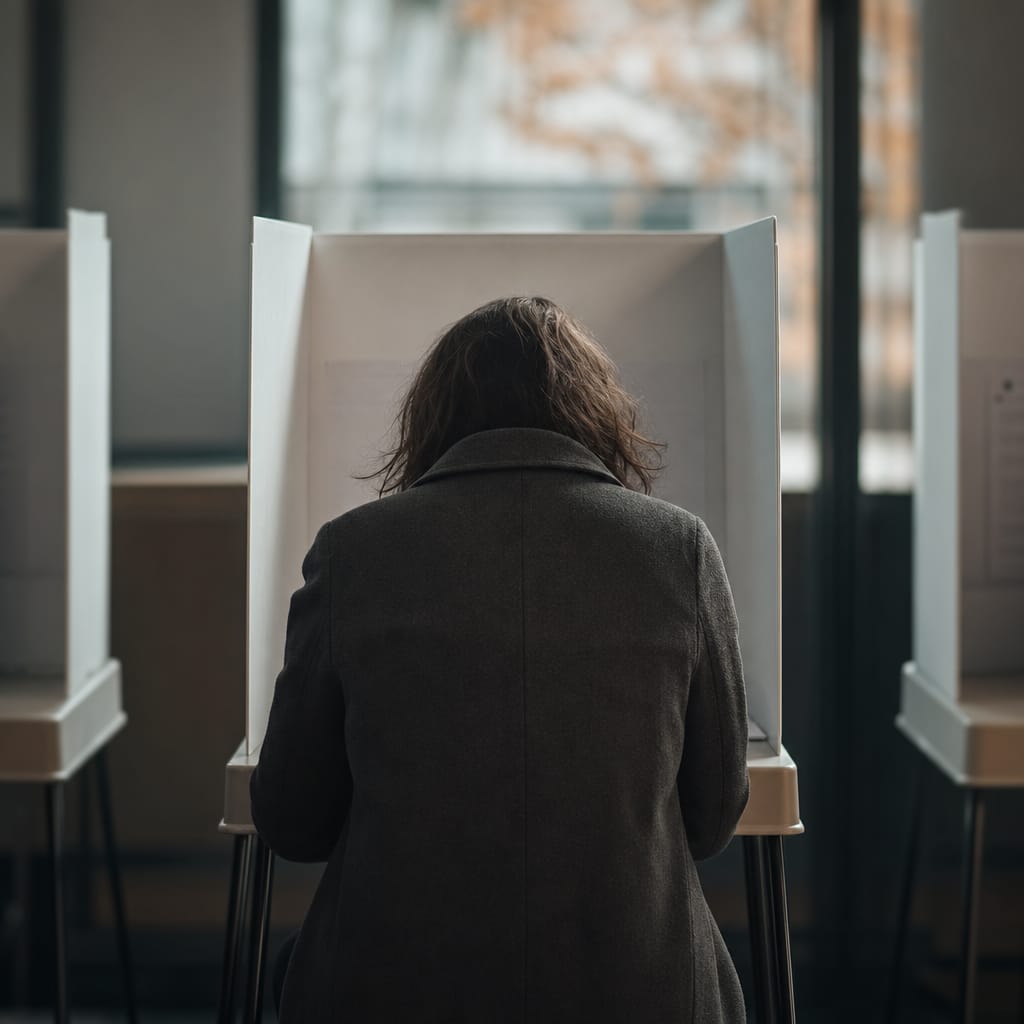
In a real democracy, you at least get to go home. The polls close, the counting starts, and for a year or three you can pretend the whole business isn't happening. A family doesn't work like that. The moment you walk through the front door, you're back in the booth.
A Continuous Set of Votes
Every household is running a continuous, overlapping set of votes on questions nobody formally put to the floor. What's for dinner. Whether nine o'clock is a reasonable bedtime for someone who is, technically, ten and a half. Whether the holiday to Lanzarote counts as "what everyone wants" when one person clearly means Whitby. These aren't conversations, exactly – they're negotiations, with each member operating simultaneously as a voter, a lobbyist, and a veto in a waistcoat. The toddler who refuses to get dressed is not being difficult. She is tabling an amendment.

The Coalition Keeps Changing
The strange thing is that the coalition keeps changing. A family of four with a seven-year-old and a four-year-old is a completely different political entity from the same family five years on. The seven-year-old has acquired opinions, counter-arguments, and a working knowledge of the phrase "that's not fair." The four-year-old has learned to time her crying for maximum effect. Suddenly the parents – who once held an effective majority by dint of being enormous – are minority partners in their own household, scrambling to build cross-party support for the motion that shoes must be worn before leaving the house.
Then the Grandparents Arrive
And then the grandparents enter the picture, which is when things really get interesting. They don't live under the same roof, but they vote anyway, somehow. A grandparent who says "oh, let him have it" at the biscuit tin has just swung the entire confectionery debate without even being present for it. Their influence is what a political theorist might call soft power, except that it mostly manifests in a six-year-old demanding to know why Nana doesn't make him eat broccoli.
What nobody tells you is that the rolling nature of it is precisely the point. No resolution. No final settlement, no ratified constitution of the household. Just an endless, mostly affectionate renegotiation of what everyone needs, what everyone can stand, and what counts as fair this particular Tuesday. The Polling Station Never Closes explores exactly this – the idea that some democratic processes don't have an off switch, and that this is not necessarily a bad thing.
Bad Governance, Workable Outcomes
Families are bad at governance in almost every technical sense. Decisions take too long, the electorate is emotionally compromised, and the person crying loudest often wins on procedure even when they're objectively wrong about the biscuit. But they're oddly good at producing outcomes everyone can more or less live with. Not through efficiency. Through sheer accumulated negotiation, conducted at kitchen tables and in car journeys and during the slow, complicated business of everyone growing up at slightly different speeds.
Nobody called the referendum. It's just always been running.
Questions this raises
- Why is family conflict harder to escape than other conflict?
- Why do family arguments repeat?
- How do you step out of a family dynamic?
- Is avoidance ever the right answer?