
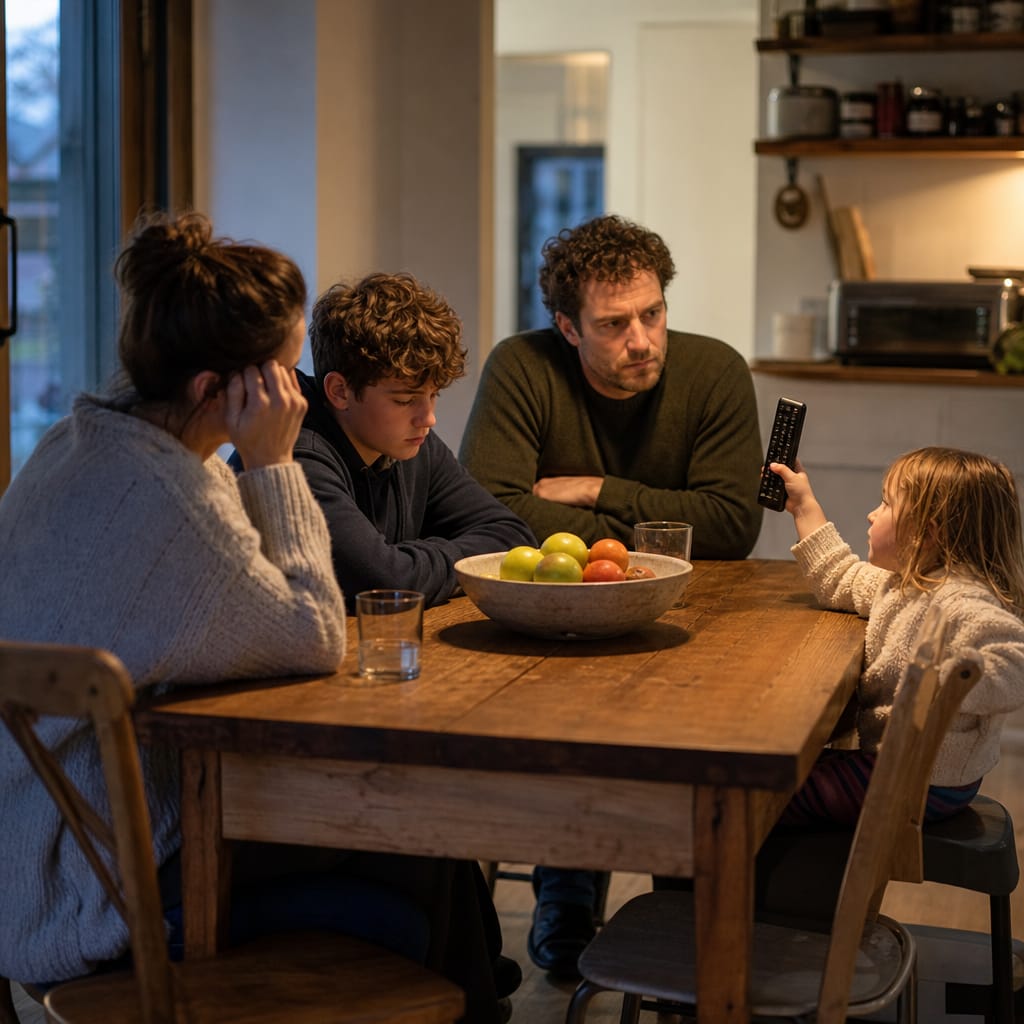
Parliament has a Speaker, a whip, a formal division lobby, centuries of procedural precedent. Your family has a kitchen table, someone who hasn't spoken since the argument about whose turn it was to put the bins out, and a four-year-old who is technically holding the remote hostage. And yet the two institutions are running roughly the same software.
The Oldest Political Unit
Families are the oldest political units most of us will ever inhabit. Long before any city-state got around to inventing a constitution, small groups of related people were already sorting out who gets what, who decides, and what happens when someone refuses to cooperate. The tools they used – persuasion, sulking, coalition-building, the strategic withholding of dinner conversation – are the same tools every formal democracy later codified and gave Latin names to.

How the Voting Weights Shift
The interesting thing is how the voting weights shift. A toddler carries extraordinary veto power, not through any formal mandate but through the sheer credible threat of making everyone's morning unbearable. This is less cute than it sounds. It is exactly how a small faction with intense preferences outmanoeuvres a passive majority. Political scientists write about this constantly. Most of them have presumably also lived through it at 7am over a disputed pair of shoes.
A teenager's silence, meanwhile, functions as abstention – technically neutral but in practice a rebuke, and felt as one by everyone present. The parent who unilaterally announces a holiday destination without consultation is governing by decree, and will generally find out within forty-eight hours what the governed think of that. The other parent who quietly lobbies the children before the big announcement is running a whipping operation. Nobody uses those words. The mechanism is identical.
Why do families have unwritten rules?
What families never have is a written constitution. The rules exist – everyone in the house knows roughly what they are – but they were never agreed, never written down, and they shift constantly as the population changes. A new baby rewrites the whole settlement without a referendum. A child leaving for university tips the balance of power overnight. These renegotiations happen through a thousand tiny signals: who sits where, who speaks first, whose preferences quietly stop being consulted. No formal vote. Total political consequence.
This is why The Polling Station Never Closes is, in a family, literally true. Every meal is a vote on what this household values. Every car journey is a negotiation over airtime, playlist, temperature, and whether we are stopping at the services or not – and for how long, and does getting a coffee count as stopping. Every bedtime is a small power struggle that one party wins differently each night depending on who has more energy and who ran out of conviction somewhere around bath time.
Muddling Through Counts
The remarkable thing is not that families argue. It is that they mostly muddle through to workable arrangements without any of the machinery that formal politics insists it cannot operate without – no written rules, no neutral arbiter, no fixed terms of office. Just ongoing, exhausting, occasionally very funny negotiation between people who didn't choose each other and can't quite leave.
Come to think of it, that description fits most parliaments too.
Questions this raises
- How are family roles assigned?
- Why do old family dynamics resurface at gatherings?
- Can family patterns be changed?