

Somewhere in your house, right now, there is a scuff mark at exactly the height of a small child's shoe. Maybe it's on the skirting board by the kitchen doorway, or the hallway wall just where a buggy used to clip the corner on the way through. You probably stopped seeing it years ago. But it's there, faithfully recording the exact dimensions of a child who no longer fits through anything at that angle.
How do houses record their occupants?
Your house has been keeping notes on you. Not through any device or camera, but through the slow, patient accumulation of physical marks left by daily life – pressed into the fabric of the place by pure repetition. A house is, among other things, an autobiography written in accidental ink. The trick is learning to read it.

Start With the Carpet
Look at your carpet near the window. There is almost certainly a patch that's slightly more flattened than the rest, faded in an oval or an oblong, where someone in your household tends to stand when they want to think. Or look out at the garden. Or just be somewhere that isn't quite the room. That worn patch is a habit made visible – it took hundreds of quiet moments to write, and you never noticed a single one of them while they were happening.
Then the Walls
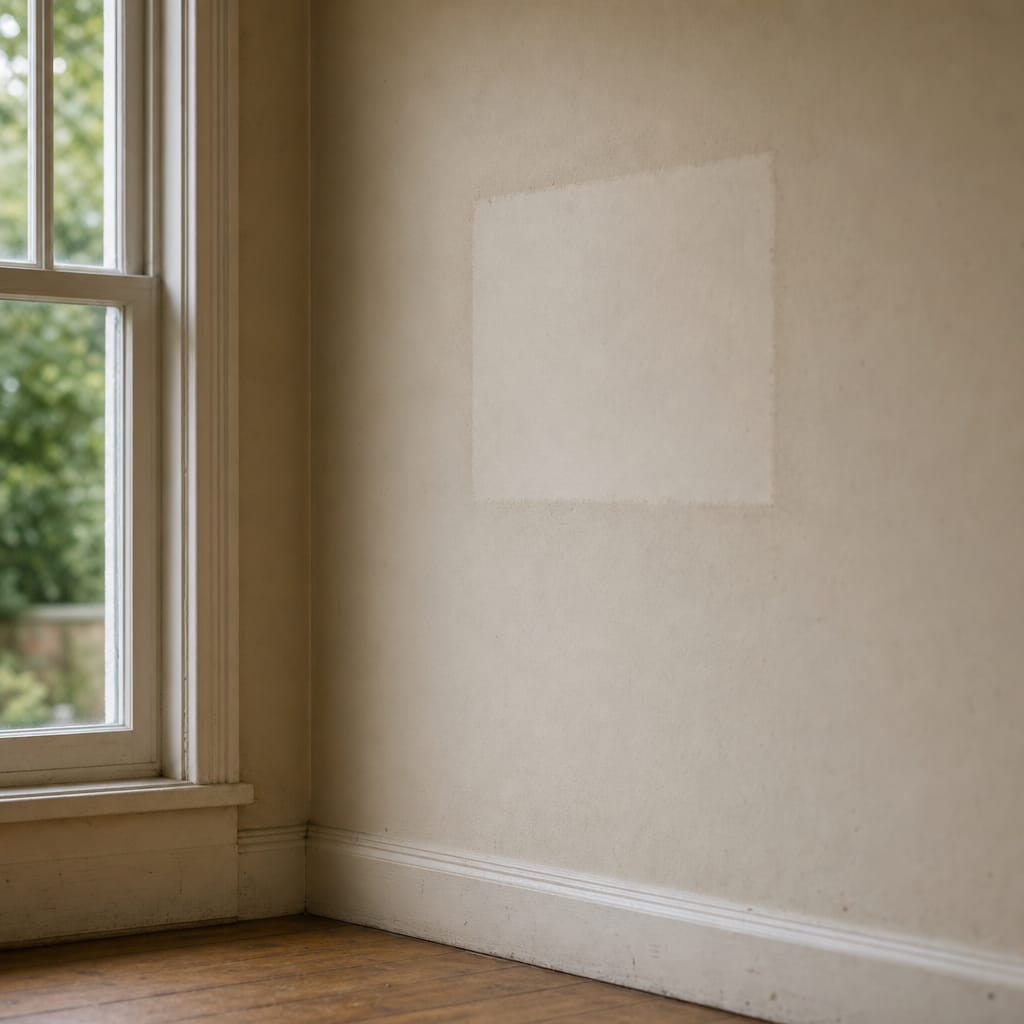
The walls do this too. A faint rectangle of brighter paint, just a shade or two deeper than the rest of the wall, marks where a picture hung for twenty years. The rest of the surface aged in the light; that patch didn't. Now the picture is in the loft or in a skip, but the wall still knows it was there. When you redecorate, you paint over the record, which is a bit like tearing a page out of a diary because the entry is embarrassing.
The kitchen door frame might have pencil marks on it – heights and dates in someone's handwriting, a whole chronology of a childhood in vertical form. Or the inside of a cupboard door might have a Blu-Tack ghost where a list was stuck for long enough to leave a faint residue. Somewhere, the inside of a drawer carries a smell you couldn't place if you tried, but which is immediately, overwhelmingly familiar.
Is it worth keeping original marks when decorating?
None of this is damage, exactly, though we tend to treat it as such when we're selling up. That's when you suddenly see the house as a document rather than just a home – when an estate agent stands in your hallway and your eyes follow theirs to the scuff, the worn patch, the faded rectangle. You find yourself reading your own biography off the walls and wondering whether to paint it out.
Sometimes it's worth pausing before you do. These marks are what a house looks like when it's actually been lived in, which is the whole point. You're Going To Enjoy This More Than You Think You Will
The house has been paying attention, even when you weren't.
Questions this raises
- What does wear and tear reveal about a home's history?
- Should you preserve signs of family life?