

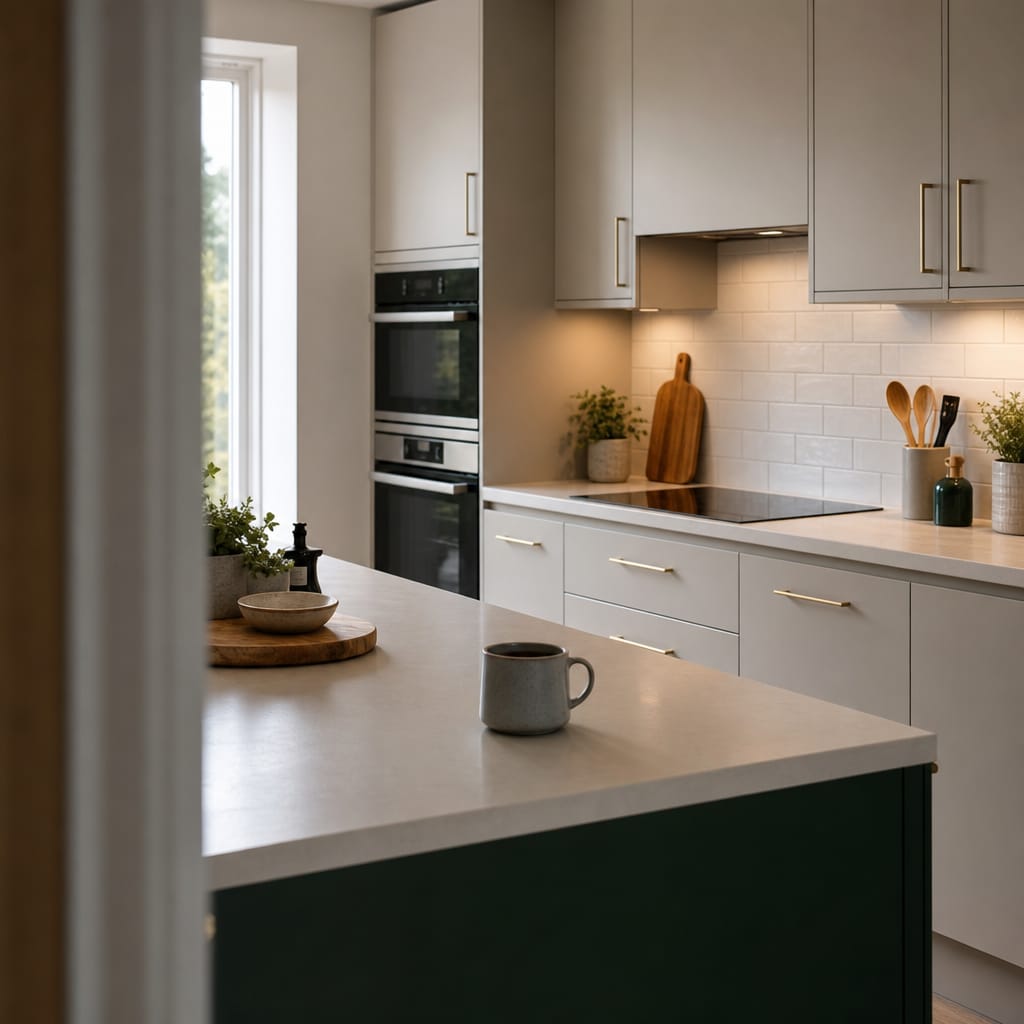
You know the feeling. You've been living with those tired cupboard doors for four years, and somewhere around year two you made yourself a quiet promise: new kitchen, new chapter. You imagine it finished – the clean worktops, the handles that match, the morning coffee ritual suddenly feeling like something from a lifestyle supplement. You will be a different, slightly better person. You are certain of this.
Then you get the kitchen.

It's lovely. It genuinely is. For about three weeks you notice it every time you walk in. Then – almost without you catching the moment it happens – you stop. The worktops become worktops. The handles are just handles. The coffee tastes like coffee. You are, to your faint bewilderment, exactly the same person you were before.
Why do home renovations rarely feel as good as imagined?
Psychologists have a name for the gap between how good you predicted this would feel and how good it actually does: impact bias. It turns out humans are spectacularly bad at forecasting their own emotional futures. Home improvements are one of the places this plays out most vividly. We imagine the finished thing will carry its emotional charge indefinitely. It won't. The brain is not built to keep marvelling at a splashback.
What is hedonic adaptation?
What happens is something called hedonic adaptation – or habituation, if you prefer the less fashionable word. The brain is essentially a change-detection machine. It notices novelty, flags it as important, and then quietly files it under "normal" once it's decided the new thing isn't a threat or an opportunity worth tracking. It did this with your last phone, your last house move, probably your last relationship in its early weeks – and a new kitchen stands no chance. Within a month, the neural response to those cupboard doors is more or less indistinguishable from the response to the old ones.
This is not a design flaw, or not exactly. The brain deprioritising the familiar is what lets you notice the unfamiliar – which is rather useful if something unfamiliar might want to eat you. Less useful when you've spent twelve grand on a kitchen extension and you're standing in it at 7am feeling entirely neutral.
What It Means for Doing, Not Having
The interesting twist is what this means for the doing of home projects rather than the done. The planning, the choosing, the Saturday spent painting – these tend to be absorbed slowly, stretched across time, interrupted by tea and mild frustration and small decisions. Attention stays on them, and they stay new for longer. The outcome arrives all at once and then immediately starts going stale.
Which is perhaps why You're Going To Enjoy This More Than You Think You Will turns out to be a fairly reliable headline for the process of improving a home, not the result of it.
We keep buying the finished thing when what we're actually enjoying, without quite realising, is the project. The new kitchen was never the point. The months of planning it probably were.
Questions this raises
- How long does the pleasure of a new kitchen last?
- How do you spend on a home without disappointment?