
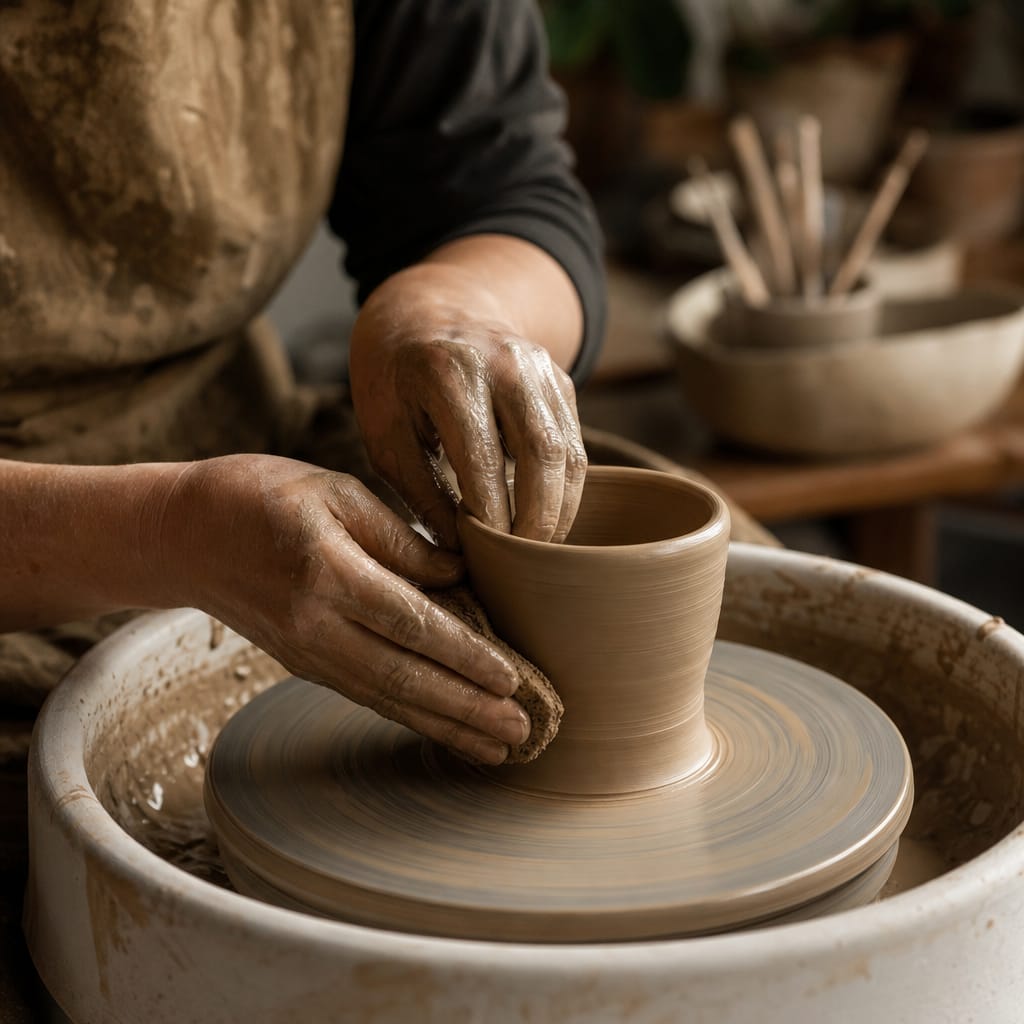
Somewhere in a community centre on a Wednesday night, a person who describes themselves as "not really a creative type" is absolutely locked in. They're making a ceramic mug. They haven't looked up in forty minutes. Their phone is face-down on the table and they couldn't tell you what time it is. Ask them what they're doing and they'll probably shrug and say "just a hobby." But their brain is doing something considerably more dramatic than that word implies.
Here's what's actually happening underneath: the reward circuitry running that Wednesday-night potter is the same circuitry that ran the people who kept our species alive on the African savannah. It wasn't built for pottery. It was built for tracking, foraging, problem-solving under pressure, and the very specific satisfaction of finishing something hard. But it turns out it cannot tell the difference.
That circuitry runs on three things, really. Novelty – the sense that this moment contains information worth attending to. Physical engagement, hands doing something, not just eyes watching. And visible progress. The bowl is taller than it was five minutes ago. The deer is closer than it was this morning. When all three are present, something clicks into place. Attention narrows, time does that odd thing where it speeds up and slows down at once, and you stop composing your grocery list in the back of your head.
Researchers sometimes call this "flow" but that word has been printed on enough motivational mugs to have lost most of its meaning. What's less talked about is the reason it feels so effortless to fall into when the conditions are right: it's because your nervous system has been doing a version of this for a very, very long time. Your conscious mind treats pottery as a leisure activity. The older, deeper parts of your brain treat it as a hunt with a visible finish line. For more on why that ancient circuitry shapes so much of modern life, Your Brain Is Running Software From 200,000 Years Ago is worth a read.
This is why certain activities feel compulsive in a way that others don't. Walking vaguely doesn't do it. But walking somewhere with a purpose – a geocache, a particular viewpoint, a timed route you're trying to beat – suddenly becomes hard to stop. Knitting plain rows doesn't hold attention the way a new stitch pattern does. The machinery wants a problem with a measurable edge.
It's also why boredom feels so physical. That restless, itchy dissatisfaction when you're just drifting isn't a personality flaw. It's old equipment designed for constant purposeful engagement, running with nothing to do.
The ordinary activities that people apologetically call "just something I do" – bouldering, bread-making, amateur astronomy, growing things in a small garden – aren't really hobbies in the trivial sense. They are, accidentally but precisely, the conditions under which very ancient systems in your brain finally get to do their job. The mug is the deer. The Tuesday evening is the hillside. Your nervous system doesn't know the difference, and frankly, it seems delighted about this.
Read next
- Your Saturday Afternoon Was Invented In About 1850
- The Alarm That Keeps Going Off In An Empty House
- The Archivist Has Already Decided
If you want an activity that holds your attention like this, see our list of hobbies to try, sorted by budget and time.
Questions this raises
- Why is making things with your hands so absorbing?
- What is flow state and how do you reach it?
- Why does craft reduce anxiety?
- Do you need to be good at a craft to benefit?