

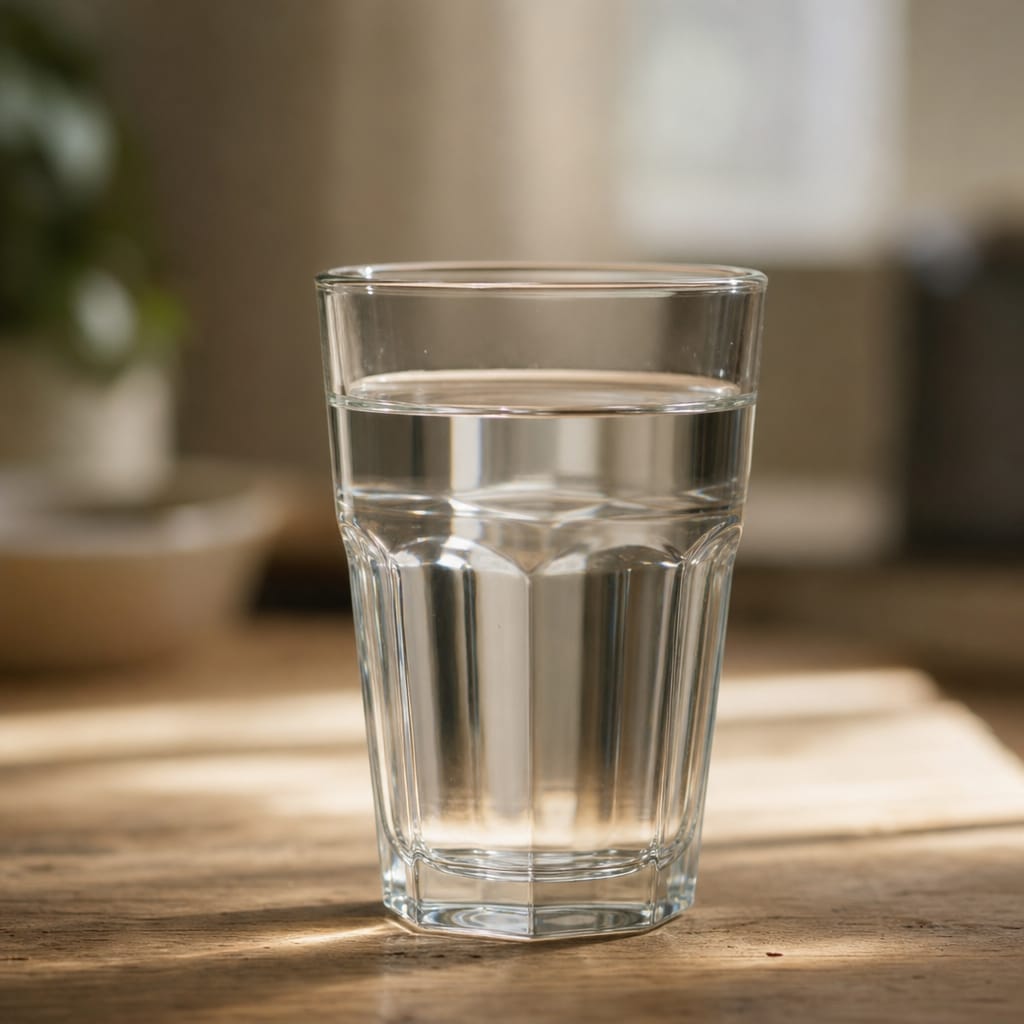
Somewhere right now, somebody is gulping down their sixth glass of water because they read they should drink eight a day. They're probably not thirsty. Just following the rule – the rule that, as far as anyone can find, does not actually exist. Or at least, nobody who cited it ever checked where it came from.

The eight-glasses-a-day figure traces back, as far as researchers can tell, to a 1945 recommendation from the US Food and Nutrition Board. They stated that a person needs about 2.5 litres of water daily. Sounds familiar, right? But here is the part that almost everyone who passed it on left out: the very next sentence said that most of this quantity is already contained in prepared foods. In other words, you are mostly fine. That second sentence got dropped in the first retelling, or the second, or the fifth, and somewhere along the way a qualified, hedged, contextual statement became the universal law you see printed on gym bottles.
It is, as you may have noticed, a very long game of Chinese whispers. Health information is particularly good at this because each link in the chain sounds like an authority. A scientist publishes something tentative. A journalist covers it, tidying up the caveats to fit into 300 words. A wellness magazine picks up that version, losing a few more qualifications along the way. A Twitter thread quotes the magazine. Your colleague quotes the thread. By the time it reaches you, it has the confidence of something carved in stone, and the connection to the original study is long gone. The Longest Game Of Chinese Whispers In The World does exactly this unravelling if you want to follow that chain properly.
The ten per cent brain myth is even more baffling when you trace it, because nobody can agree who said it first. Einstein has been blamed. William James, the psychologist, has been blamed too. There are references to early neuroscience experiments where, if you damaged a portion of the brain, the patient sometimes recovered – which was misread as proof that the rest was redundant. In reality, brain imaging shows we use virtually all of it, just not all of it at once. The same way you are not flexing every muscle in your body simultaneously right now. The myth was probably useful: it sounds motivational, it flatters us, it suggests potential just waiting to be unlocked.
What both of these share is that they were plausible. Not true, but close enough to something that had been said by someone credible, at some point, in some context. That is how a piece of information survives thirty retelling cycles – it has to rhyme with the truth, even if it has long since stopped being it.
The genuinely odd part is not that these myths exist. It is that once you know how they form, you start noticing the caveats being stripped out in real time. In articles you are reading this week.
Read next
Questions this raises
- Do you really need eight glasses of water a day?
- Where did the eight-glasses rule come from?
- How much water do you actually need?
- Does tea or coffee count towards hydration?