

For at least two generations of people who were paying attention in biology class, the annual warning to go and get a coat in autumn would be snootily shot down with a reference to the viruses that cause the common cold. Cold air doesn’t give you colds. The myth had been debunked, so for a while there it was a dead issue and we all felt somewhat superior at Christmas.
Turns out we were a bit previous.
The Correction That Still Stands
Rhinovirus, responsible for the majority of the colds we suffer, is transmitted from person to person, not by weather. So you can’t get a cold from cold air alone. You may get chapped hands and face spending a January fortnight alone on Scottish hills, but you won’t get sniffly. This part of the debunking is correct.
The Part Nobody Mentioned
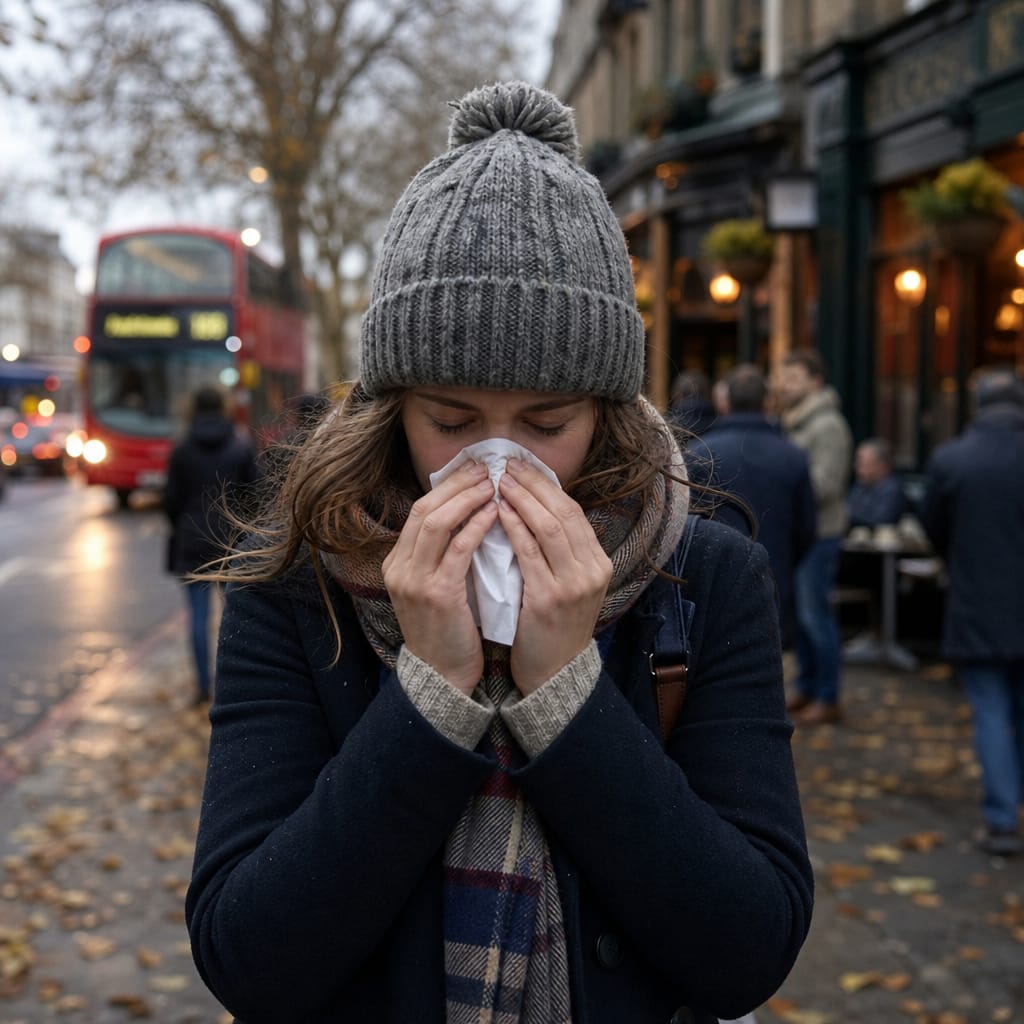
Rhinoviruses are thought to replicate best at temperatures around 33°C. The immune system at core body temperature (37°C) is usually able to suppress such viruses effectively. However, at temperatures around 33°C, the immune system is less able to tackle these invaders. 33°C is about the temperature of nasal passages after twenty minutes outside on a British October day.
Cold air does not give you a cold. It just cools your nasal passages to close to the ideal incubation temperature for any rhinovirus you then meet indoors – in your local office, on the bus or in the warm pub where everyone has gone to escape the cold weather that has just chilled your nose.
For more on how small conditions shape bigger outcomes than they appear to, Every Time You Do Something, You're Voting is worth a read.
An Accident of British Meteorology
Although your gran hadn’t quite got the mechanism of infection right, the combination of cold air from outside and going from cold to warm within the houses of lots of people was a reliable feature of the British weather throughout the winter months. Thus the necessary sequence of cold air followed by crowded spaces that makes the biology click was to be found in the normal pattern of weather for every person in the country, throughout the winter months. She had therefore observed something which was true but explained it for the wrong reasons: she had mistaken two things which were always to be found together for each other.
Mildly annoying if you spent years correcting her at the front door.
—
Does wearing a scarf over your nose actually do anything?
It might, a little. If you keep your nasal passages closer to 37°C, you stay in the range where rhinovirus replication is better suppressed. Whether a scarf does enough to make a measurable difference is genuinely hard to say, but the idea is no longer daft.
So if it's not the cold itself, why do people clearly get more colds in winter?
There are several factors that contribute to virus circulation. The first is that people are in close proximity to each other indoors. Low humidity from central heating is thought to aid the virus in staying in the air for longer periods of time. Decreased levels of vitamin D, with less sunlight, also affect the immune system as vitamin D is known to have an important role in immune function. Note, these are not the whole cause, but each contributes a little.
Is this 33°C thing specific to rhinovirus, or do all cold viruses behave this way?
Mostly a rhinovirus story. It causes more colds than any other single virus, but respiratory syncytial virus, certain coronaviruses and adenoviruses also produce cold symptoms and have different biology. The temperature sensitivity is particularly pronounced in rhinovirus.
Can cold weather genuinely weaken your immune system, or is that definitely a myth?
Sleep and stress do not cause colds directly. However, chronic poor sleep and chronic stress can weaken your immune system, and in the winter months, that is often going on. In addition, there is some evidence that cold dry air can cause the tiny hairs in the airways, which normally sweep pathogens out of the body before they can settle, to vibrate slightly less. This is not the same as weakening your immune system, but it can have negative effects as well.
FAQ
Can you catch a cold from cold air?
There is one virus which is known to cause the majority of common colds – the rhinovirus. This is a virus which is spread from person to person and NOT through weather. But cold air can cool your nose in such a way that it is more susceptible to the virus when indoors.
What temperature does rhinovirus replicate best at?
Rhinoviruses are thought to have an optimal temperature for replication at around 33°C. At 37°C (core body temperature) they are usually suppressed by the immune system but at 33°C it is less able to control the virus. The temperature of the nasal passages can drop to about 33°C after 20 minutes outside on a British October day.
Why do more people get colds in winter?
The increase in cases of winter colds is believed to be caused by a combination of factors. People generally spend more time indoors with others during the winter months, the low humidity in heated buildings is thought to help viruses remain in the air for longer and there is less vitamin D in our bodies due to lack of sunlight, which affects immune function.
Does wearing a scarf over your nose help prevent colds?
There’s no conclusive evidence that wearing a scarf will help prevent winter colds, but it might have a slight positive effect by keeping the nose closer to 37°C, which is the temperature at which rhinovirus replication is better suppressed. How much of an effect it would have is unknown but it is no longer considered to be an absurd idea.