

Somewhere inside your phone there are billions of transistors. Each one flips between on and off billions of times a second. Each flip produces a tiny pulse of heat – negligible on its own, the warmth of a match being struck in an empty stadium.
But you are not alone on the internet.
The Moment a Switch Becomes a Furnace
A data centre is the building where your photos are stored and where your recommendations are calculated. Millions of chips are running simultaneously in such a building. Every search, every scroll and every piece of content lined up for you causes more switches to change place and thus more heat to be produced. A data centre thus generates the output of an industrial furnace and it keeps running all the time, whether you are online or not.
This is not a software problem. Physics does not issue patches.
Cold Air Is the Cheapest Cooling System Ever Built
The traditional fix is mechanical refrigeration: enormous air conditioning units that consume nearly as much electricity cooling the machines as the machines use doing their actual work. Expensive, and a bit absurd.
Then someone looked at a map.
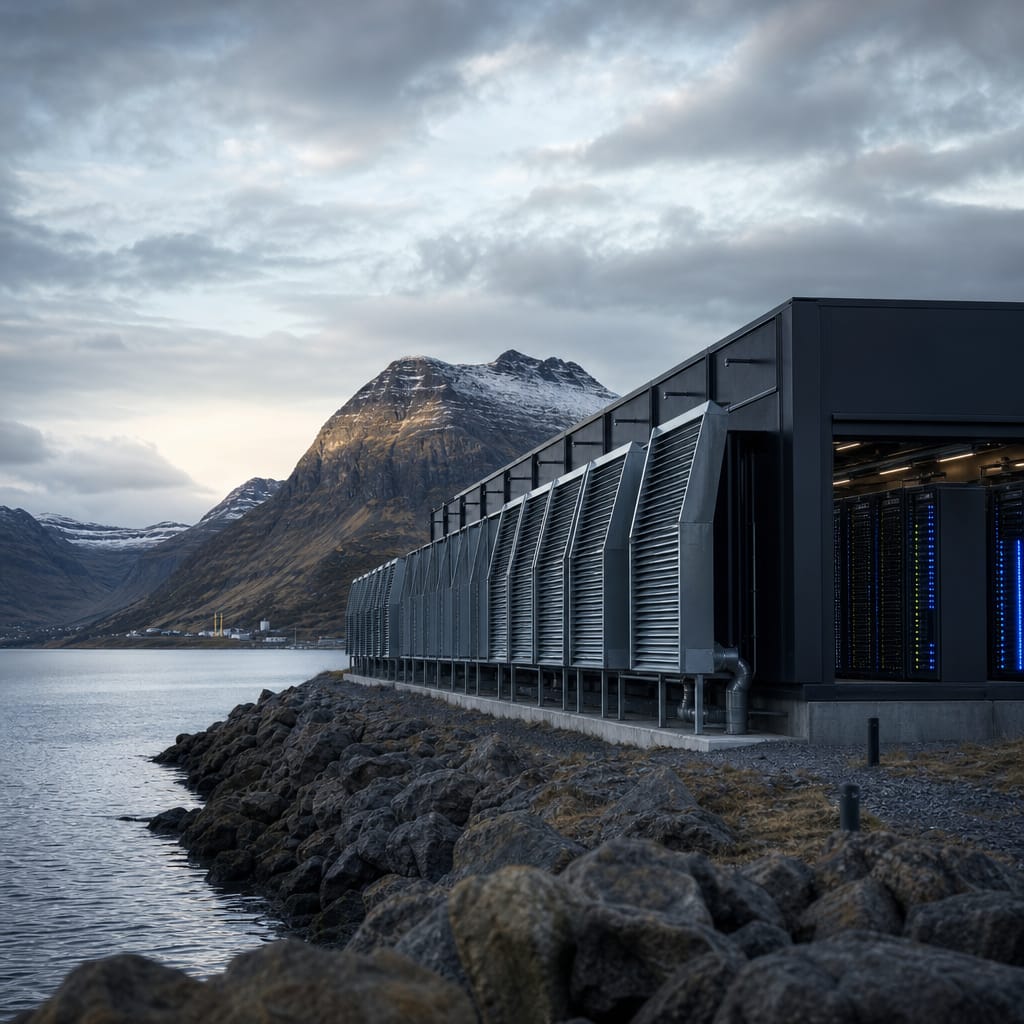
The ambient air in the Norwegian fjords, the Scottish Highlands and Iceland is cold enough for much of the year to open up a building and let the outside air cool it down. The fact that your actions online can affect things far beyond your feed is explored further in Every Time You Do Something, You're Voting. In Iceland this is combined with geothermal power, so machines can be powered and cooled almost entirely with energy from the landscape. Several of the world's largest data centres are now located within a few hundred miles of the Arctic Circle.
What That Has to Do With Your Saturday Evening
There's an invisible factor in where the internet actually lives. It's not a corporate strategy decision. It's the temperature outside. The recommendations you see, the way your timeline is organised, your search results – all were likely computed in a building with windows open to the North Atlantic. The internet does not live in a cloud. It is a bunch of very warm buildings in very cold places.
Do they really just open the windows?
Essentially, yes – it's called free cooling. In cold-climate facilities, it handles most of the temperature management for most of the year. Then mechanical refrigeration kicks in for the unusually warm days. In Iceland, some facilities run on free cooling almost year-round.
Why not build everything near the Arctic?
Latency. When serving users in London, Reykjavik servers are physically further away and the extra milliseconds count for live services. But most cold-climate sites' work is less time-sensitive: storage, backups, batch processing etc. So, whatever handles your live video call is likely to be much closer to home than you'd think.
Is Scotland actually significant here?
The Central Belt is growing fast, with many large data centres attracted by the climate, Scotland’s surplus of renewable electricity and the fact that the major transatlantic undersea cables come ashore on the west coast of Scotland. Having large processing capacities close to these cables makes sense. The geography is in favour of continued growth of data centres in the Central Belt.
Does moving north make data centres greener?
It cuts the energy wasted on cooling, which is genuine progress. The honest answer is that it makes the process more efficient, not clean. The electricity demand from processing itself keeps growing – free cooling addresses one part of the problem, not the whole of it.
FAQ
Do data centres really just open the windows to cool down?
For most parts of the year, cold climate data centres rely on free cooling to cool the air. Outside air is allowed into the data centre and this air is used to remove heat from the servers. Mechanical refrigeration is used for short periods of high ambient temperature but for the majority of the time free cooling is sufficient to cool the data centre. Some data centres in Iceland even run on free cooling almost throughout the year.
Why not build every data centre near the Arctic?
Latency is the main reason here, as Reykjavik is far from London. Thus cold-climate sites are typically used for non-time-critical work like storage, backups and batch processing, whereas real-time applications like live video calls are likely served from centres much closer to end-users.
Why is Scotland important for data centres?
Scotland is well-suited to data centres for three reasons: the climate, the surplus of renewable electricity available and the fact that major transatlantic undersea cables come ashore on the west coast of Scotland. It makes sense to have large processing capacity near the point where the cables come ashore, and the geography favours continued growth of data centres in the Central Belt of Scotland.
Does moving data centres north make them greener?
Moving the operation to the North would save on a lot of the energy that would otherwise be wasted on cooling, so yes that is real progress. But that isn’t to say that all would be well, because while the operation as a whole would become more efficient, the fact is that it isn’t made clean by that. Power consumption by the processing itself continues to rise and so tackling that one portion of the problem with free cooling isn’t sufficient.