

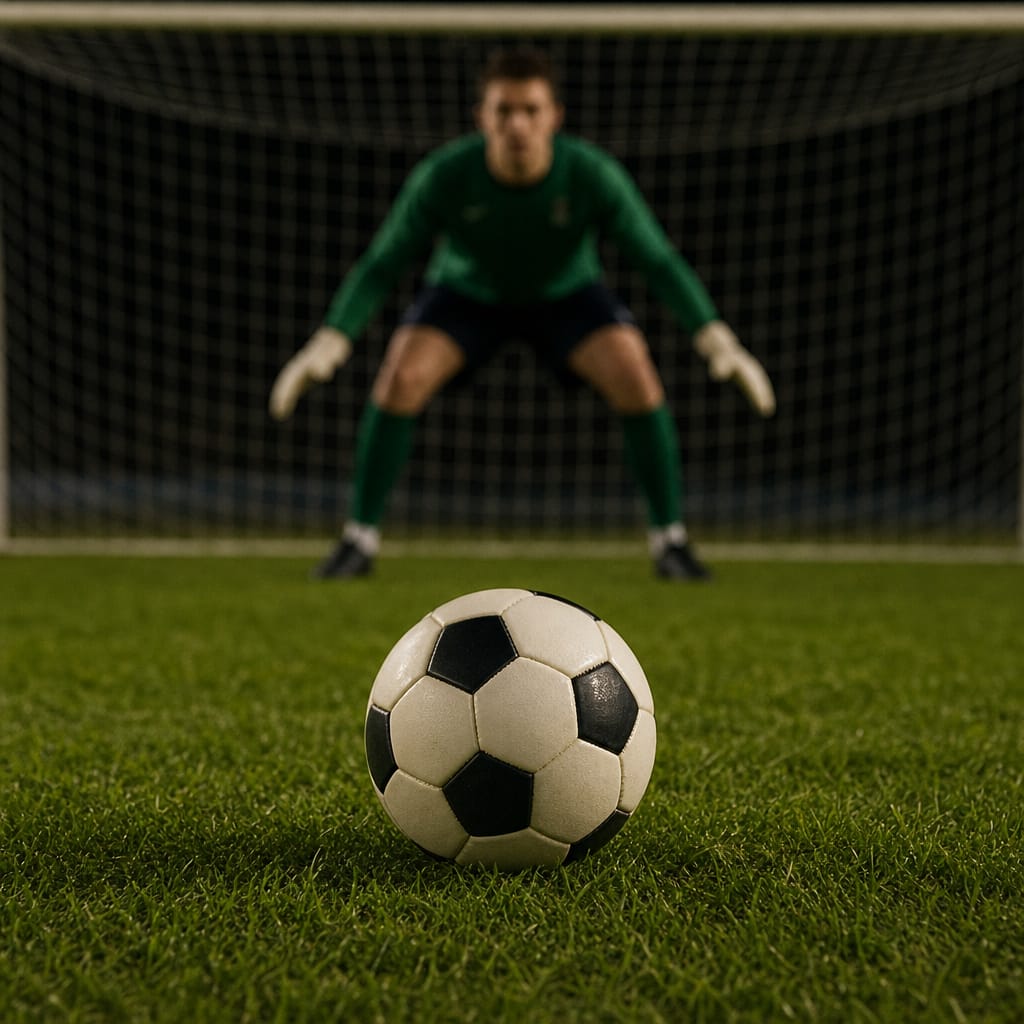
Watch a penalty shootout through your fingers and you'll notice something odd. The player who buries it is usually the one who looks like he's thinking about something else entirely – the weekend, his dinner, nothing much. The one who blazes it over the bar? He walked up slowly, stared at the goalkeeper for about four seconds too long, and had what sports commentators love to call "too much time to think." They're right, but not in the way they mean.
Here's what's actually going on.

Two Modes of Motor Control
Your brain has two rough modes for controlling movement. One is conscious, deliberate, analytical – the bit of you that learned to drive, that could narrate every step. The other is automatic, pre-loaded, fast. It's the bit that now drives you to work while you're thinking about something else entirely. The automatic system is extraordinary. It runs complex, finely tuned physical sequences faster than your conscious mind can even form a thought, let alone interfere with one. The snooker player who's potted a million balls doesn't think about the angle of his elbow. He just pots the ball.
Until someone tells him the championship depends on it. Then he does think about the angle of his elbow.
What is choking under pressure?
What researchers call "choking" isn't a character failing or weak nerves in any simple sense. It's what happens when the conscious brain – that slow, worrying, well-meaning part – elbows its way back into a process it trained itself out of for good reason. The analytical system grabs the controls back from the automatic one. Suddenly a movement your body has rehearsed ten thousand times becomes a movement you are actively trying to perform. Like trying to walk down stairs by thinking about each step. You'll stumble.
This is, as it happens, a glitch baked in long before snooker existed. Your brain is running software from 200,000 years ago, and the part of you that catastrophises under pressure was probably quite useful when the pressure was a predator, not a goalkeeper. It floods you with attention, saying: this matters, check everything. In the Serengeti that was the right call. On the penalty spot it is an absolute disaster.
How do athletes avoid overthinking?
Elite athletes don't learn to care less, which is what it might look like from the outside. They learn – often through quite deliberate training – to keep the conscious brain busy with something meaningless so it can't meddle. A pre-shot routine is essentially a distraction for the part of you that would otherwise be running catastrophe calculations. Humming, counting, focusing on a spot – something, anything, to occupy the wrong half of the management structure while the right half gets on with it.
Trying Harder Makes It Worse
The baffling part, and the part that took researchers a while to accept, is that "trying harder" is often the precise mechanism of failure. More effort, more attention, more focus on technique. These are not the solution to choking. In many cases they are the definition of it.
Useful information for the next time someone tells a footballer to just concentrate.
Questions this raises
- Why does trying too hard cause missed penalties?
- Does practice under pressure help?