

In 1996, a team at Nvidia had a problem: triangles. Thousands of them, each needing to be transformed, lit, and placed on a screen sixty times a second. A regular processor had far too much else to manage, so they built a chip to do almost nothing except one specific operation – matrix multiplication – using thousands of tiny processors firing at once, each handling one piece of the same enormous sum. The chip made Lara Croft's shadows look right. It also, without anyone planning it, laid the foundation for the systems now reading chest X-rays inside the NHS.
The Operation at the Bottom of Both Things
Rendering a 3D scene and training a neural network come down to the same mathematical core: multiplying vast grids of numbers, over and over, in parallel. In a game, the matrix describes a triangle rotating in space. In a neural network, it describes the strength of connections between layers of artificial neurons – millions of them, all updating at once as the system learns. A standard CPU does this brilliantly but sequentially. A GPU does it more crudely but in thousands of streams simultaneously. When researchers in the early 2010s first ran AI training on gaming hardware, the speed jumped by something like fifty times. Not because anyone planned a crossover – because the maths happened to be the same maths.
What the AI Is Actually Doing With the Image
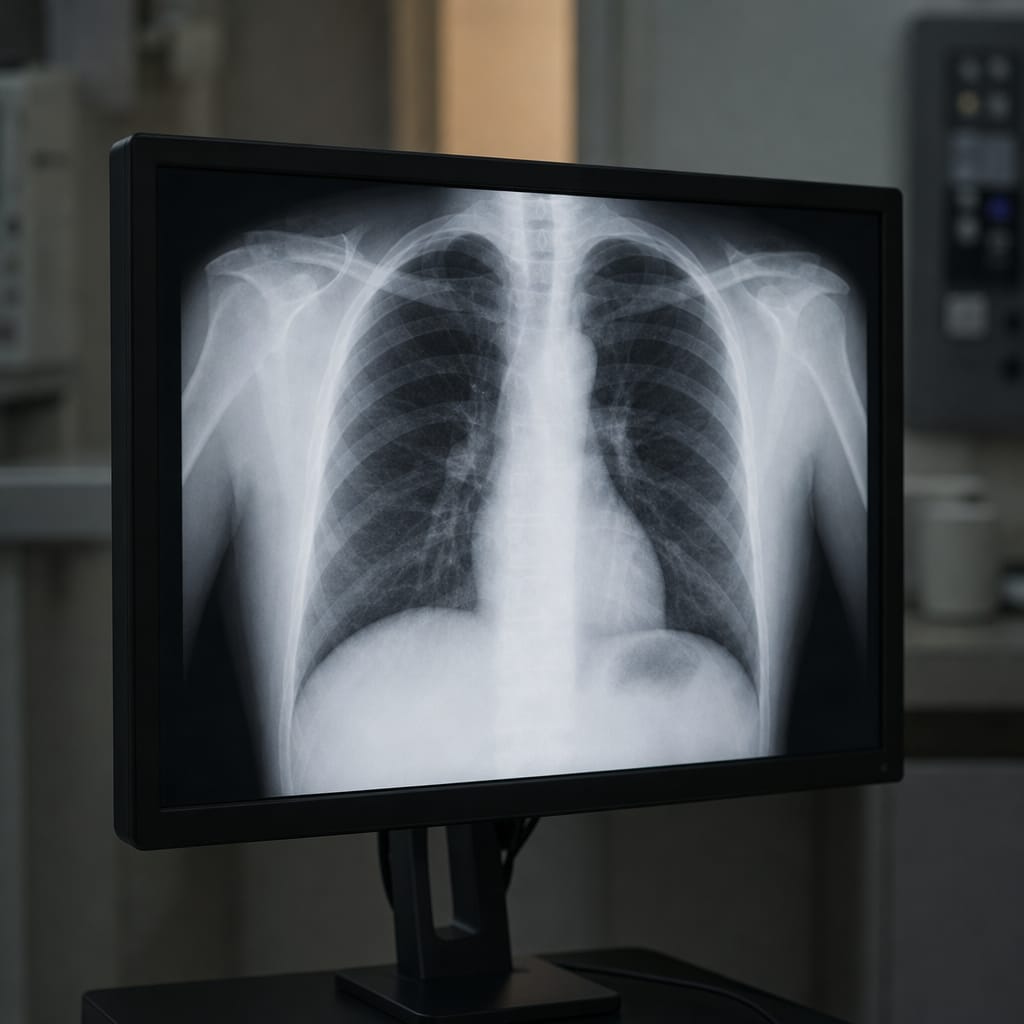
When an AI reads a chest X-ray, it isn't looking the way a radiologist does. A radiologist brings years of visual memory: the particular haziness that experience teaches you to watch. The AI has something stranger – a map of pixel-relationship patterns built from millions of labelled scans, across so many dimensions it couldn't be drawn. It doesn't see a shadow. It registers that the arrangement of pixel values here resembles, across dozens of abstract dimensions, arrangements it learned to associate with certain findings. Closer to a massive simultaneous vote than a diagnosis.
The NHS Picked Up Where Nvidia Left Off
The systems now used in NHS chest X-ray triage run on Nvidia hardware – a direct descendant of the chip built for video game graphics in the late 1990s. Medicine didn't build this infrastructure. It inherited it through a chain of choices that nobody was coordinating at the time. There's a piece elsewhere on this blog – Every Time You Do Something, You're Voting – that picks up that thread.
The GPU was not designed for any of this:
"The NHS belongs to the people. It is there to improve our health and wellbeing, supporting us to keep mentally and physically well, to get better when we are ill and, when we cannot fully recover, to stay as well as we can to the end of our lives."
Department of Health and Social Care, The NHS Constitution for England
But here we are.
Does the AI explain why it flagged something?
Honestly, no – and that bothers clinicians. The system can highlight a region of the image that influenced its output, but it can't explain its reasoning the way a doctor can. The field calls this the explainability problem: a system can be very accurate at finding things without being able to give reasons a human can interrogate. Doctors need to be able to question a finding, and "the network said so" isn't enough on its own.
Will this replace radiologists?
Not the way "replace" implies. Current NHS deployments use it as a triage tool – flagging scans that need urgent attention and deprioritising ones that look clear, which helps departments work faster without removing the radiologist from the loop. The bottleneck in radiology isn't skill, it's volume. That's specifically the part the GPU helps with.
What if the training data was skewed?
Then the system won't be equally accurate for everyone, which is a real problem. If the millions of scans it trained on came mostly from a particular demographic – older patients, or images taken on certain equipment – it learns those patterns most reliably and may perform less well for everyone else. This is the live argument in medical AI right now, and why training data diversity has become one of the central concerns in the field.
FAQ
Why can a chip built for video games be used to train AI?
A gaming chip is good for AI because both gaming and AI compute huge grids of numbers multiplied together in parallel. A GPU runs thousands of streams at once. A CPU on the other hand computes in a straight line, one stream at a time. When researchers in the early 2010s first trained AI on gaming hardware, they saw a jump in speed of something like 50 times.
Can an AI explain why it flagged something on a chest X-ray?
No, not in the way a doctor can. While a system may highlight a part of an image that it used to arrive at a particular conclusion, such systems are not able to provide sufficient explanation for a human to scrutinise the findings in detail. This is referred to as the explainability problem and it is a sensitive issue for clinicians, who need to be able to question a finding.
Will AI replace radiologists in the NHS?
No, not in the way the word implies. In general, current NHS deployments of AI in radiology use it as a triage tool to highlight urgent images and de-prioritise ones that look clear. This helps a department with a large volume of images to deal with them faster while keeping the radiologist in the loop. The current bottleneck in radiology is volume, not skill, and that is what the GPU helps with.
What happens if the data used to train a medical AI is skewed?
The system will not be equally accurate for every patient. The AI may perform less well on patients who are not part of the demographic of the majority of patients in the training data (e.g. if most were older patients), and also on patients whose images were acquired on different equipment from the majority of images in the training data. This is one of the reasons why diverse training data is a central concern in the field of medical AI.