
Think about the last time you went for a swim, turned out for a Sunday league game, or found yourself watching eleven men chase a ball around a field for exactly ninety minutes. Where did any of that actually come from? Not your personal history. The actual thing itself. Why ninety minutes? Why Saturday? Why these activities and not a hundred others?
The answer is a campaign. A grinding, decades-long campaign fought mostly by textile workers in northern England who wanted an afternoon off.
The Half-Holiday and the People Who Won It
Before the 1850s most factory hands in Britain worked six full days a week. That meant that Saturday was just another day at work. It wasn’t until the Early Closing Movement and a number of Factory Acts were introduced that by the 1870s the movement had achieved its modest but historic aim: a half-day on Saturday. Typically this would be from about one o’clock in the afternoon.
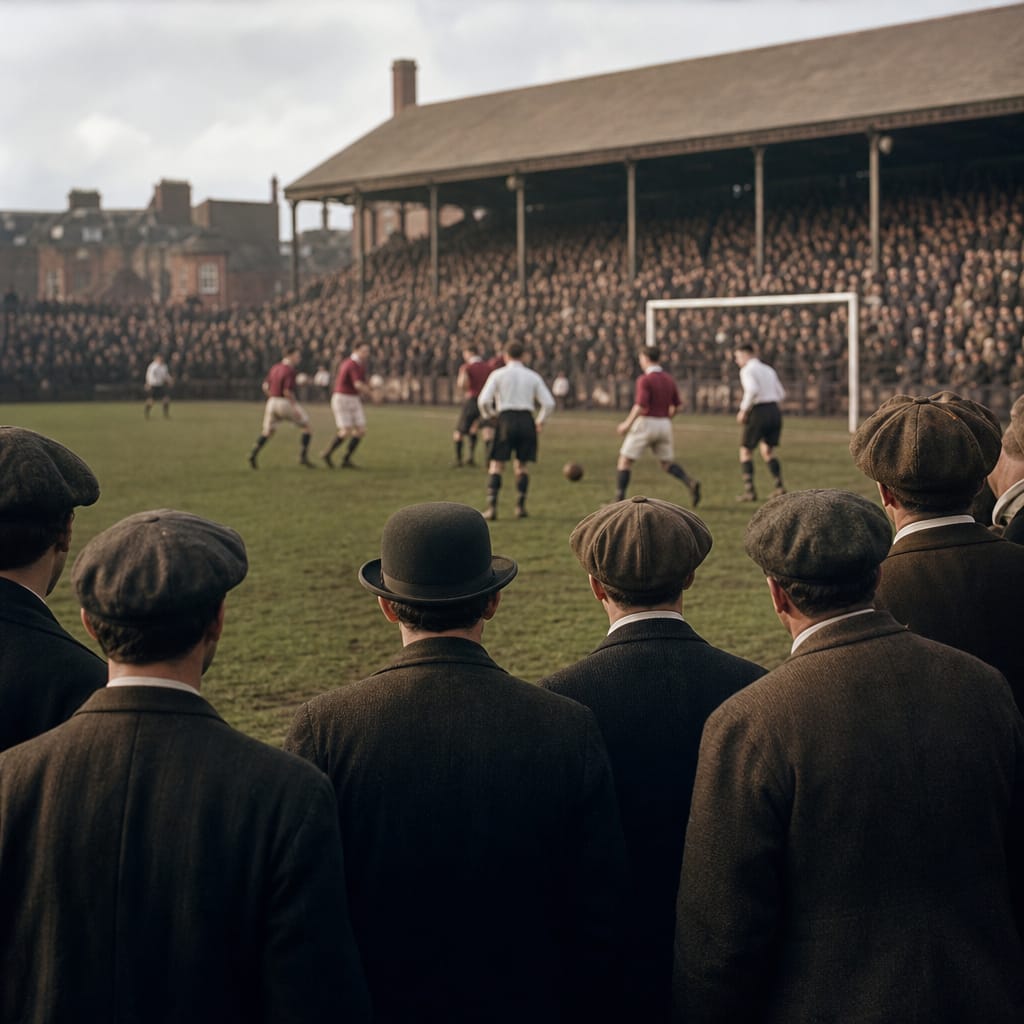
Three to four hours. That was the slot.
What the Slot Could Fit
Three to four hours is a specific slot of time. You can travel to a local football ground, watch a match and get home before it gets dark. You can go for a run with a local cycling club, have a swim at newly opened public baths or go for an afternoon of cricket. Fox hunting, long country walks and most country pursuits of the upper classes require you to have your own time.
The Football Association was founded in 1863 and the Football League in 1888. A ninety-minute match is a neat package which can be slotted into a three to four hour slot. Cricket, cycling clubs, public swimming baths etc. all scaled to this time slot. Others that didn’t were left to the classes who still had the whole day to spend as they wished.
The Inheritance Nobody Chose
This is the bit that should stop you. You did not choose football as your national sport. Your great-great-grandparents did not exactly choose it either. Football survived a filter. This filter was a brutal, practical three-hour audition. Things that were too expensive, too time-consuming or too reliant on horses were rejected from this audition.
The things that did survive, however, went on to become part of a culture. That culture is what became a tradition and the reason we go out on a Saturday afternoon and watch whatever it is we watch without really questioning why we do it.
It’s a three-hour test. If it had been a two-hour half-holiday, or arrived in a different season, or had landed in a different industry, then we’d be watching something different on Saturday afternoon. Something that fitted.
Want to dig deeper into how choices compound through generations like this? Every Time You Do Something, You're Voting is worth a read.
The original vote, though, was cast by mill workers who simply wanted a few hours off. It's worth wondering what they'd make of the Premier League.
—
Why is a football match ninety minutes specifically?
Ninety minutes became the standard length of a game of football gradually throughout the Football League years of the 1880s and 1890s, not from a single ruling. For long matches, the evening would be eaten into, and short matches would not be worth the journey to the other side of town. The fact that matches were played on a Saturday fixed in the minds of football followers what was correct, and that became the rule.
Did the half-holiday apply to everyone, or just factory workers?
Factory workers got it first through legislation, but the pressure spread. Shop workers, clerks, and tradespeople campaigned for similar terms through the same decades. By the 1880s, Saturday afternoon free time had become common enough across working life that it started behaving like a social institution.
What leisure activities didn't survive this period?
Many retreated up the social ladder and stayed there. Activities such as extended country sports, or pursuits that involved significant travelling or equipment that would need to be carried by servants, were confined to individuals who were from the beginning of their lives never required to work on a Saturday. A century or so later, some of these pursuits have filtered back into the mainstream of society but others remain as estranged from it as ever.
Is the club structure of British sport connected to this?
Yes, almost certainly. The Saturday half-holiday model was a club model by nature: a fixed time, a fixed place, the same set of people every week, and so it needed something to house the regularity of it all. The social function of football and cricket clubs in Victorian towns was in part a solution to a scheduling problem: here’s where we go at one o’clock on a Saturday.
Did the cycling boom really happen this early?
This is one of the more striking examples. While the penny-farthing had a brief flurry of popularity in the 1870s, it was the safety bicycle of around 1885 that really took off, as it was so much more practical and affordable for ordinary workers to get on and ride. And as soon as the safety bicycle had appeared, cycling clubs sprang up all over Britain. This was because club runs fitted perfectly into the afternoon, and apart from the cost of purchasing a bike to start with, cost almost nothing.
For a modern take on how to spend a weekend, see our guide to hobbies to try, with 40 ideas sorted by budget and time.
FAQ
When did British workers get a Saturday half-day?
Prior to the 1850s most factory hands worked 6 full days a week, but through the Early Closing Movement and various Factory Acts the Saturday half-day had been won by the 1870s, typically commencing around 1 o’clock in the afternoon and allowing workers a roughly 3-4 hour period in which to amuse themselves.
Why did football become so popular on Saturday afternoons?
A 90 minute match is neatly contained within a 3 to 4 hour time slot and thus fans could travel to and attend matches and be home before dark. The Football Association was founded in 1863 and the Football League in 1888. Football suited workers with limited time.
Which pastimes did not suit the Saturday half-holiday?
Football, cricket, cycling clubs and public swimming baths were activities that could be spread over a three-to-four hour period. Activities like fox hunting and long country walks were more suited to people who had the whole day at their disposal and thus generally remained the preserve of those classes.
What was the three-hour audition for Saturday pastimes?
A good pastime had to fit into a three-to-four hour slot on a Saturday afternoon. Activities that cost too much, required too much time, or relied too heavily on horses were rejected, while the activities that did manage to be included became part of the culture and tradition. Today we head out on a Saturday afternoon without a second thought.